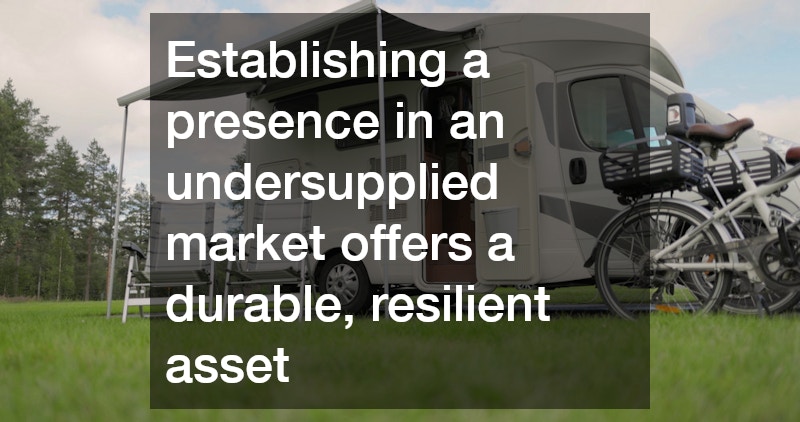





The commercial real estate landscape has seen niche asset classes transition from overlooked side projects into institutional-grade investments, and vehicle storage sits right at the center of this shift. With millions of households owning recreational vehicles or boats, the sheer volume of large-format recreational equipment in circulation has reached historic highs. At the same time, municipal zoning restrictions and strict Homeowners Association covenants increasingly prohibit owners from parking oversized motorhomes and travel trailers in suburban driveways or residential streets. This dynamic creates a persistent supply-demand mismatch that makes commercial parking properties an exceptionally attractive entry point for investors seeking stable cash flow, lower operational friction, and high net operating income margins.
Market Dynamics and Operational Efficiency
When evaluating whether this sector represents a strong allocation of capital, the underlying operational economics provide a compelling foundation. Unlike multi-family housing or retail centers—which carry heavy capital expenditure requirements, turnover costs, and continuous tenant maintenance—vehicle storage operates on a remarkably lean expense structure. Operating expense ratios for dedicated parking assets are noticeably lower than those of standard self-storage facilities and multi-tenant residential properties.
This operational efficiency translates into strong fundamentals across several key performance metrics:
-
Favorable Yield Potential: Stabilized sites offer attractive initial yields compared to traditional commercial real estate sectors due to low ongoing capital expenditure demands.
-
Strong Net Operating Income Margins: Because facilities require minimal staffing, negligible utility consumption, and limited ongoing upkeep, net operating income margins remain exceptionally high.
-
Sticky Customer Base: Tenant turnover sits at an exceptionally low monthly churn rate, with average tenant tenure spanning multiple years. Unlike traditional self-storage users who clear out after life events like residential moves, RV owners view storage as an ongoing utility cost of their discretionary lifestyle.
-
Low Delinquency: Vehicle owners protecting high-value leisure assets demonstrate strong payment reliability, keeping default and eviction rates well below broader commercial real estate averages.
Because land requirements are substantial, well-situated rv storage facilities benefit from natural competitive moats once established, protecting existing operators against rapid oversupply in local trade areas.
Comparing Facility Types and Revenue Streams
Investors entering the market can choose between several distinct physical configurations, each carrying different operational profiles, infrastructure commitments, and target tenant bases:
-
Uncovered Outdoor Storage: Requires basic grading, gravel or asphalt surfacing, perimeter fencing, and access controls. This configuration offers the lowest development footprint, minimal initial capital requirements, and the fastest lease-up pace, making it ideal for owners seeking functional, accessible parking for standard towable trailers.
-
Canopy and Covered Storage: Features steel overhead structures, paved stalls, and wide drive aisles. It strikes a strong balance between sun protection and structural simplicity, appealing directly to mid-to-high-tier travel trailer and motorhome owners looking to preserve their vehicle finishes.
-
Enclosed and Fully Structured Facilities: Utilizes individual garage bays, roll-up doors, and optional electrical hookups. This format delivers maximum security and complete weather protection, commanding premium leasing interest from luxury motorhome owners seeking long-term asset protection.
Beyond baseline space rentals, modern operators enhance facility productivity by introducing complementary ancillary services. Adding automated wash bays, dumping stations, propane refill stations, battery tender hookups, and specialized insurance options allows operators to expand top-line revenue with minimal additional labor. Furthermore, many modern rv storage facilities integrate solar panel arrays on canopy roofs, generating secondary income streams through net metering agreements or power sales back to local utility grids.
Key Risks and Due Diligence Factors
While the operational metrics are highly favorable, investing in this space involves distinct challenges that require thorough upfront evaluation:
-
Large Footprint Requirements: Sites require sizeable parcels—typically spanning multi-acre tracts—to accommodate wide drive aisles and spacious turning radii necessary for large Class A rigs and long travel trailers.
-
Entitlement and Zoning Barriers: Securing land that is both conveniently located and properly zoned can present hurdles. Municipal planning boards often mischaracterize open vehicle parking as industrial yards, making conditional use permits and local approvals a primary development timeline factor.
-
Location Sensitivity: Facilities relying on distant, poorly accessible rural land may struggle with lease-up momentum. Optimal locations reside within short drive times from high-density suburban communities with high household incomes and active covenants, or along major transportation corridors leading to popular recreation destinations.
-
Competitor Pipeline Risk: Because unpaved outdoor storage can technically be established quickly where zoning permits, investors must conduct rigorous market analyses to ensure competing developments are not in the permitting queue within the immediate trade radius.
Thorough site selection and operational planning ensure that newly established or acquired rv storage facilities maintain high occupancy levels and resilient performance through changing macroeconomic cycles.
Investing in dedicated recreational vehicle storage represents a compelling commercial real estate strategy that merges high profit margins, predictable recurring revenue, and low operational overhead. For investors willing to navigate the initial site selection, land acquisition, and local entitlement processes, establishing a presence in an undersupplied market offers a durable, resilient asset that reliably builds long-term value.